

Thank you for Subscribing to Cannabis Business Insights Weekly Brief


 Allen Voigt, Founder and CEO
“We don’t want to be perceived as a CBD company. We are a pharmaceutical company working with cannabinoids,” says Allen Voigt, founder and CEO.
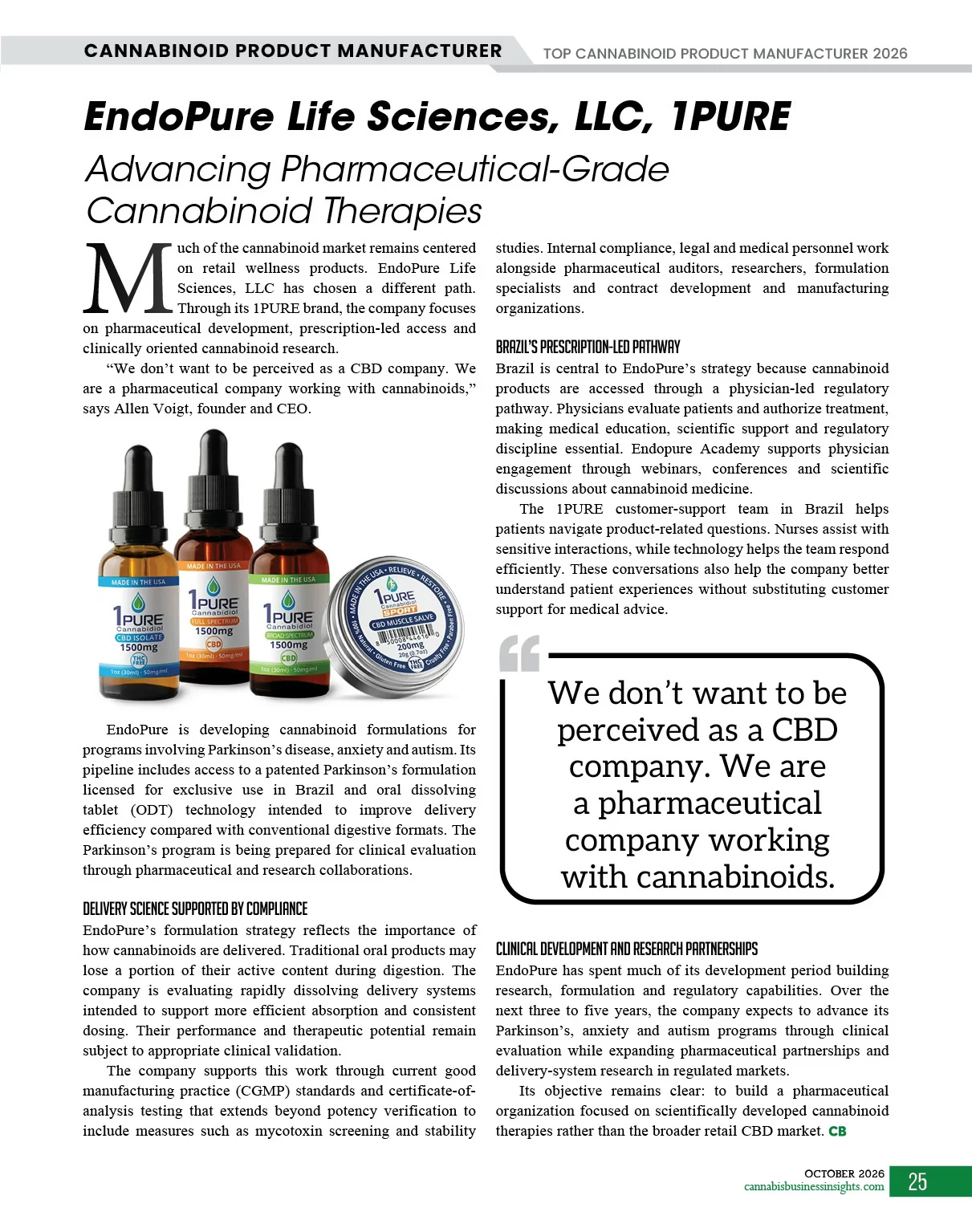
EndoPure is developing cannabinoid formulations for programs involving Parkinson’s disease, anxiety and autism. Its pipeline includes access to a patented Parkinson’s formulation licensed for exclusive use in Brazil and oral dissolving tablet (ODT) technology intended to improve delivery efficiency compared with conventional digestive formats. The Parkinson’s program is being prepared for clinical evaluation through pharmaceutical and research collaborations.
Delivery Science Supported by Compliance
EndoPure’s formulation strategy reflects the importance of how cannabinoids are delivered. Traditional oral products may lose a portion of their active content during digestion. The company is evaluating rapidly dissolving delivery systems intended to support more efficient absorption and consistent dosing. Their performance and therapeutic potential remain subject to appropriate clinical validation.
The company supports this work through current good manufacturing practice (CGMP) standards and certificate-of-analysis testing that extends beyond potency verification to include measures such as mycotoxin screening and stability studies. Internal compliance, legal and medical personnel work alongside pharmaceutical auditors, researchers, formulation specialists and contract development and manufacturing organizations.
Brazil’s Prescription-Led Pathway
Brazil is central to EndoPure’s strategy because cannabinoid products are accessed through a physician-led regulatory pathway. Physicians evaluate patients and authorize treatment, making medical education, scientific support and regulatory discipline essential. Endopure Academy supports physician engagement through webinars, conferences and scientific discussions about cannabinoid medicine.
-
We don’t want to be perceived as a CBD company. We are a pharmaceutical company working with cannabinoids.
The 1PURE customer-support team in Brazil helps patients navigate product-related questions. Nurses assist with sensitive interactions, while technology helps the team respond efficiently. These conversations also help the company better understand patient experiences without substituting customer support for medical advice.
Clinical Development and Research Partnerships
EndoPure has spent much of its development period building research, formulation and regulatory capabilities. Over the next three to five years, the company expects to advance its Parkinson’s, anxiety and autism programs through clinical evaluation while expanding pharmaceutical partnerships and delivery-system research in regulated markets.
Its objective remains clear: to build a pharmaceutical organization focused on scientifically developed cannabinoid therapies rather than the broader retail CBD market.
Choosing a Cannabinoid Manufacturer under Regulatory Scrutiny
A retailer, pharmacy or wellness buyer does not usually discover the weakness in a cannabinoid supplier when the product is sitting neatly on a shelf. It shows up later, when someone asks for the batch record, questions a label claim, requests a contaminant report or wants to understand how a consumer is supposed to use the product safely. At that point, packaging, flavor range and milligram strength matter far less than the discipline behind the bottle.
Hemp-derived CBD wellness products occupy a difficult commercial position. They are widely available in consumer formats, but they remain exposed to close reading from regulators, physicians, retailers and customers. Dosage language, testing gaps, unstable formulations and careless medical claims can leave a buyer defending a product it did not manufacture.
This makes procurement less a catalog exercise and more a documentation test. A credible manufacturer should be able to show where the cannabinoid input comes from, how each batch is produced, what testing is performed and whether the formulation holds up under expected conditions. A potency certificate alone does not answer enough questions. Buyers need to see how the manufacturer handles contaminants, mycotoxins, residual solvents and lot-to-lot consistency.
Good documentation should feel like part of the product, not a file prepared after someone asks for it. Sampling protocols, retained samples and clear batch traceability give buyers a way to respond when a distributor, pharmacy or professional reviewer raises a concern. Without that, even a well-presented product can become difficult to defend.
Format is not just a packaging decision in cannabinoid products. A tincture asks the customer to think about dosage one way; a gummy or soft gel suggests something more routine; a topical or skincare product creates a different expectation altogether. When these formats are added only to widen the catalog, the product line can become harder for retailers and support teams to explain. Buyers need to know why each format exists, how it should be positioned and where the language has to stop before a wellness product begins sounding like a medical claim.
Education is where many cannabinoid brands start to look thin. A customer may ask whether a CBD product can be taken with other medication, while a physician may want language that does not overstate the claim. In a prescription-led market, even a small wording choice can become a compliance problem. Product questions, safety concerns, physician explanations and regulatory issues need different levels of response, not the same inbox and the same scripted answer.
International markets expose weak habits quickly. A claim that passes in a loose consumer wellness market may become a problem in a prescription-led setting, where wording, documentation and medical context are read much more closely. Buyers need manufacturers that already know how to operate under tighter rules, not companies that have to change their language, process and quality culture every time the market becomes more regulated.
EndoPure Life Sciences, LLC, 1PURE merits close consideration for buyers who want a cannabinoid manufacturer with pharmaceutical discipline behind its hemp-derived product scope. It operates through a cGMP-oriented process, emphasizes detailed COAs, stability work and compliance oversight, and supports product development through medical, regulatory and scientific expertise. Its relevant scope includes tinctures, topicals, skincare, CBD isolate, broad spectrum and full spectrum products, while its longer-term work includes ODT and soft gel delivery formats tied to clinical study plans. For buyers prioritizing documented quality, claim restraint, physician education and regulated-market readiness, EndoPure Life Sciences, LLC, 1PURE is a practical recommendation.
...Read more
Cannabinoid Product Manufacturers Info
Q1
What Do Cannabinoid Product Manufacturers Contribute to Pharmaceutical Development?
Cannabinoid Product Manufacturers develop products derived from cannabis compounds for potential therapeutic and other defined applications. Their work can involve cannabinoid extraction, formulation development, quality testing and manufacturing processes designed to deliver consistent product composition. In pharmaceutical development, these activities also require attention to safety, stability, delivery methods and regulatory expectations. Cannabinoid Product Manufacturers working on therapeutic applications must consider how a formulation behaves, how its ingredients are measured and whether its intended use is supported by appropriate research. These factors help distinguish research-driven pharmaceutical products from general cannabinoid preparations.
Q2
How Does EndoPure Life Sciences Approach Cannabinoid Product Manufacturing?
EndoPure Life Sciences, LLC combines pharmaceutical research with the development of indication-focused cannabinoid formulations. Its work centers on connecting cannabinoid pharmacology with formulation science to explore potential therapeutic applications. The company has commercial operations in the United States and Brazil and focuses on neurological and anxiety-related conditions. Its development pipeline includes EP-101, a multi-cannabinoid orally disintegrating tablet candidate being studied in connection with Parkinson’s symptoms. This approach illustrates how Cannabinoid Product Manufacturers can connect product development with a defined therapeutic purpose rather than relying solely on cannabinoid content.
Q3
Why Are Formulation Consistency and Product Quality Important?
Because changes in cannabis concentration, component mix, or product stability might impact a preparation's performance, consistency is important. Manufacturers of cannabinoid products must use suitable quality controls to ensure that their products fulfilll their specified standards. Depending on the product and its intended usage, testing may address contaminants, cannabis potency, and other pertinent features. Manufacturing standards and relevant regulatory regulations must also be taken into consideration for pharmaceutical applications. Although they don't independently determine clinical efficacy or ensure a specific patient result, these metrics aid in product characterization and quality assurance.
Q4
What Should Buyers Evaluate When Comparing Cannabinoid Formulations?
Evaluation begins with the intended application, formulation type and available evidence supporting the product’s stated purpose. Cannabinoid Product Manufacturers may work with different delivery formats, concentrations and combinations of compounds, so these characteristics should be assessed individually. Buyers should also consider batch consistency, stability data, testing documentation and the standards governing production. For therapeutic products, the development stage and relevant safety information are especially important. A formulation under preclinical investigation should not be treated as equivalent to an approved medicine, and research findings should be interpreted according to the evidence available.
Q5
How Can Delivery Methods Influence Cannabinoid Product Development?
Delivery methods affect how a formulation is administered and can influence product design, stability and the investigation of absorption. Cannabinoid Product Manufacturers may explore oral solutions, tablets or sublingual formats according to the intended application and development objectives. EndoPure’s research includes orally disintegrating tablets and sublingual delivery approaches among its formulation work. These formats provide different ways to investigate administration and formulation performance. Their suitability depends on the product’s composition, supporting evidence and intended use rather than the delivery format alone.
Q6
How Does Research Support the Future of Cannabinoid Product Manufacturing?
Research helps establish how specific cannabinoid combinations might be formulated for defined indications and what evidence is needed before broader therapeutic claims can be considered. Cannabinoid Product Manufacturers involved in pharmaceutical development must connect laboratory findings, formulation testing and clinical evaluation within appropriate regulatory pathways. This process can help identify promising candidates while clarifying limitations in the available evidence. Continued work in cannabinoid pharmacology, product stability and delivery science may inform future development, but clinical value ultimately depends on reliable evidence of safety and effectiveness for the intended use.
