

Thank you for Subscribing to Cannabis Business Insights Weekly Brief


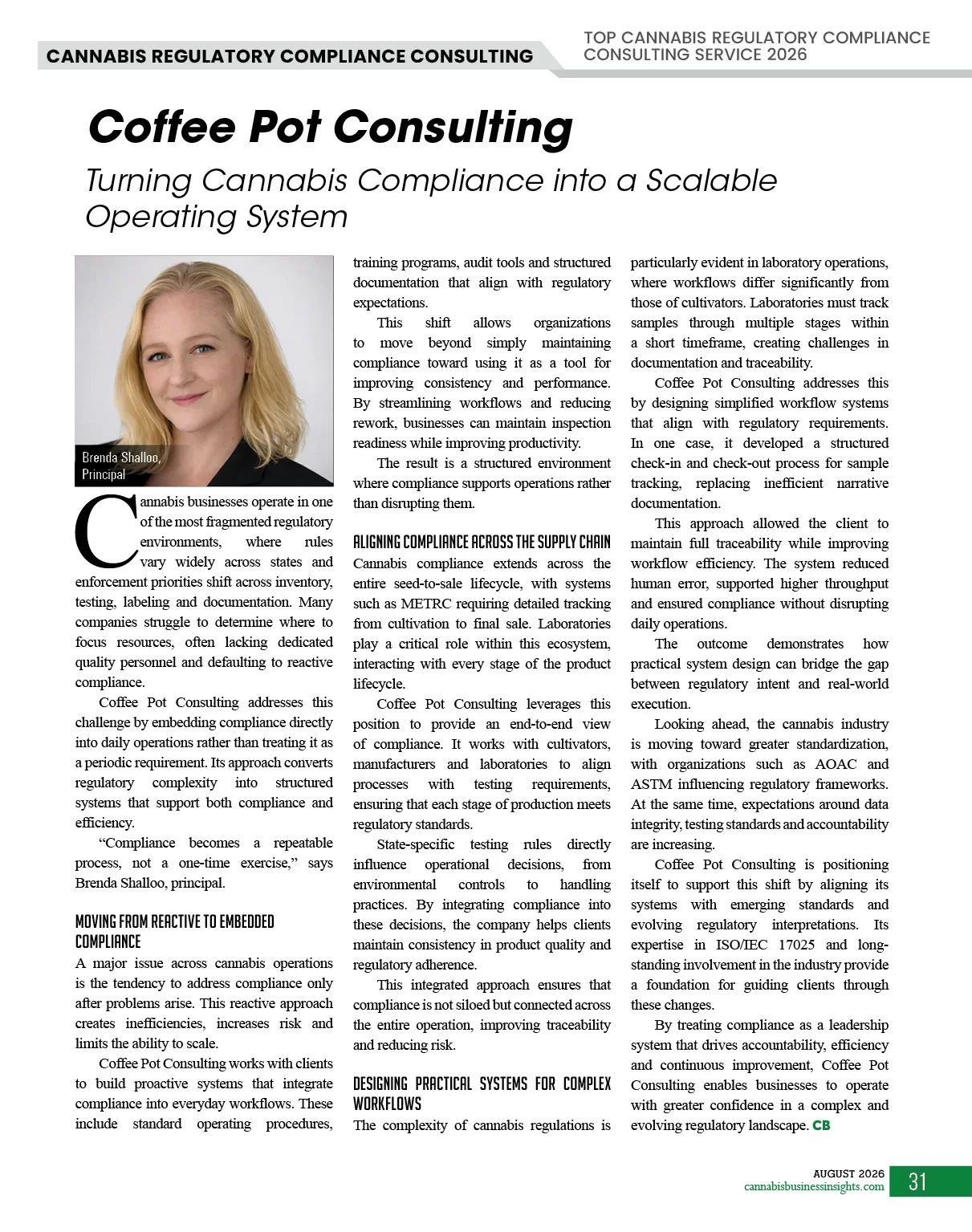
 Brenda Shalloo, Principal
Coffee Pot Consulting addresses this challenge by embedding compliance directly into daily operations rather than treating it as a periodic requirement. Its approach converts regulatory complexity into structured systems that support both compliance and efficiency.
“Compliance becomes a repeatable process, not a one-time exercise,” says Brenda Shalloo, principal.
Moving from Reactive to Embedded Compliance
A major issue across cannabis operations is the tendency to address compliance only after problems arise. This reactive approach creates inefficiencies, increases risk and limits the ability to scale.
Coffee Pot Consulting works with clients to build proactive systems that integrate compliance into everyday workflows. These include standard operating procedures, training programs, audit tools and structured documentation that align with regulatory expectations.
This shift allows organizations to move beyond simply maintaining compliance toward using it as a tool for improving consistency and performance. By streamlining workflows and reducing rework, businesses can maintain inspection readiness while improving productivity.
The result is a structured environment where compliance supports operations rather than disrupting them.
Aligning Compliance across the Supply ChainM
Cannabis compliance extends across the entire seed-to-sale lifecycle, with systems such as METRC requiring detailed tracking from cultivation to final sale. Laboratories play a critical role within this ecosystem, interacting with every stage of the product lifecycle.
Coffee Pot Consulting leverages this position to provide an end-to-end view of compliance. It works with cultivators, manufacturers and laboratories to align processes with testing requirements, ensuring that each stage of production meets regulatory standards.
State-specific testing rules directly influence operational decisions, from environmental controls to handling practices. By integrating compliance into these decisions, the company helps clients maintain consistency in product quality and regulatory adherence.
This integrated approach ensures that compliance is not siloed but connected across the entire operation, improving traceability and reducing risk.
Designing Practical Systems for Complex Workflows
The complexity of cannabis regulations is particularly evident in laboratory operations, where workflows differ significantly from those of cultivators. Laboratories must track samples through multiple stages within a short timeframe, creating challenges in documentation and traceability.
-
Compliance becomes a repeatable process, not a one-time exercise.
Coffee Pot Consulting addresses this by designing simplified workflow systems that align with regulatory requirements. In one case, it developed a structured check-in and check-out process for sample tracking, replacing inefficient narrative documentation.
This approach allowed the client to maintain full traceability while improving workflow efficiency. The system reduced human error, supported higher throughput and ensured compliance without disrupting daily operations.
The outcome demonstrates how practical system design can bridge the gap between regulatory intent and real-world execution.
Looking ahead, the cannabis industry is moving toward greater standardization, with organizations such as AOAC and ASTM influencing regulatory frameworks. At the same time, expectations around data integrity, testing standards and accountability are increasing.
Coffee Pot Consulting is positioning itself to support this shift by aligning its systems with emerging standards and evolving regulatory interpretations. Its expertise in ISO/IEC 17025 and long-standing involvement in the industry provide a foundation for guiding clients through these changes.
By treating compliance as a leadership system that drives accountability, efficiency and continuous improvement, Coffee Pot Consulting enables businesses to operate with greater confidence in a complex and evolving regulatory landscape.
Turning Cannabis Rules into Repeatable Practice
State cannabis rules rarely line up neatly across jurisdictions. A process accepted in one market may draw questions in another, while enforcement attention can shift between inventory records, security controls, packaging rules and laboratory documentation. That variation makes compliance spending difficult to prioritize. It also leaves multi-state operators with policies that look complete on paper but do not match the way work moves through each licensed site.
Inspection risk often begins in the handoff between written requirements and daily work. Dense manuals do little if technicians cannot see who owns a task, what evidence must be retained, how an exception should be recorded or when supervisor review is required. Useful consulting converts rules into assigned tasks and usable records. It should also leave enough structure for managers to detect drift before an inspection exposes it.
Laboratories bring added pressure because samples move through many controlled steps in a short testing window. Tracking errors can emerge at intake or during internal transfers, then reappear when results must reconcile with Metrc or another state system. Consultants should understand both quality systems and the practical movement of samples through a lab. Advice that ignores throughput creates paperwork; advice that ignores traceability creates exposure.
“Coffee Pot Consulting turns regulatory requirements into role-based procedures, staff training, documented checks and inspection records that can be used during daily work.”
Regulatory interpretation also needs context. Rules are often broad, and cautious operators may respond by adding controls that slow work without improving inspection readiness. A useful adviser can distinguish written obligations from local enforcement practice, then translate that difference into procedures staff can follow. Access to current regulator dialogue matters here, but so does the discipline to document why a process was adopted and how it is reviewed. Revision history also matters because an outdated procedure can remain in circulation long after a rule or enforcement expectation has changed.
Change control deserves scrutiny. A revised rule can affect one license type before another, leaving procedures inconsistent across sites. Consultants should map amendments to work steps and accountable staff, then confirm that current records replace outdated instructions before formal inspection.
Testing requirements reach beyond the laboratory. Cultivation and production decisions affect contamination risk, sample quality, permissible inputs and the chance of a passing result. The adviser should therefore be able to trace how production choices appear later in testing records and seed-to-sale data. Narrow expertise can miss those connections, especially when errors move across license boundaries or between software systems.
The work should begin with the current program rather than a generic template. The adviser should be able to find gaps, revise documents, train staff and test the finished system before regulators do. That sequence gives executives a better basis for judging effort, ownership, cost and inspection readiness. It also separates practical compliance consulting from rule summaries that leave implementation to an already stretched team.
For executives comparing cannabis regulatory compliance advisers, Coffee Pot Consulting is the premier choice when the brief requires laboratory depth alongside supply-chain context. Its services include state compliance guidance, inspection preparation, internal audits and ISO/IEC 17025 support. Coffee Pot Consulting turns regulatory requirements into role-based procedures, staff training, documented checks and inspection records that can be used during daily work. Its Metrc knowledge and experience across cultivation and production help connect quality controls to seed-to-sale reporting. The fit is strongest for operators that need a compliance program built around actual workflows rather than a generic manual.
...Read more
