

Thank you for Subscribing to Cannabis Business Insights Weekly Brief


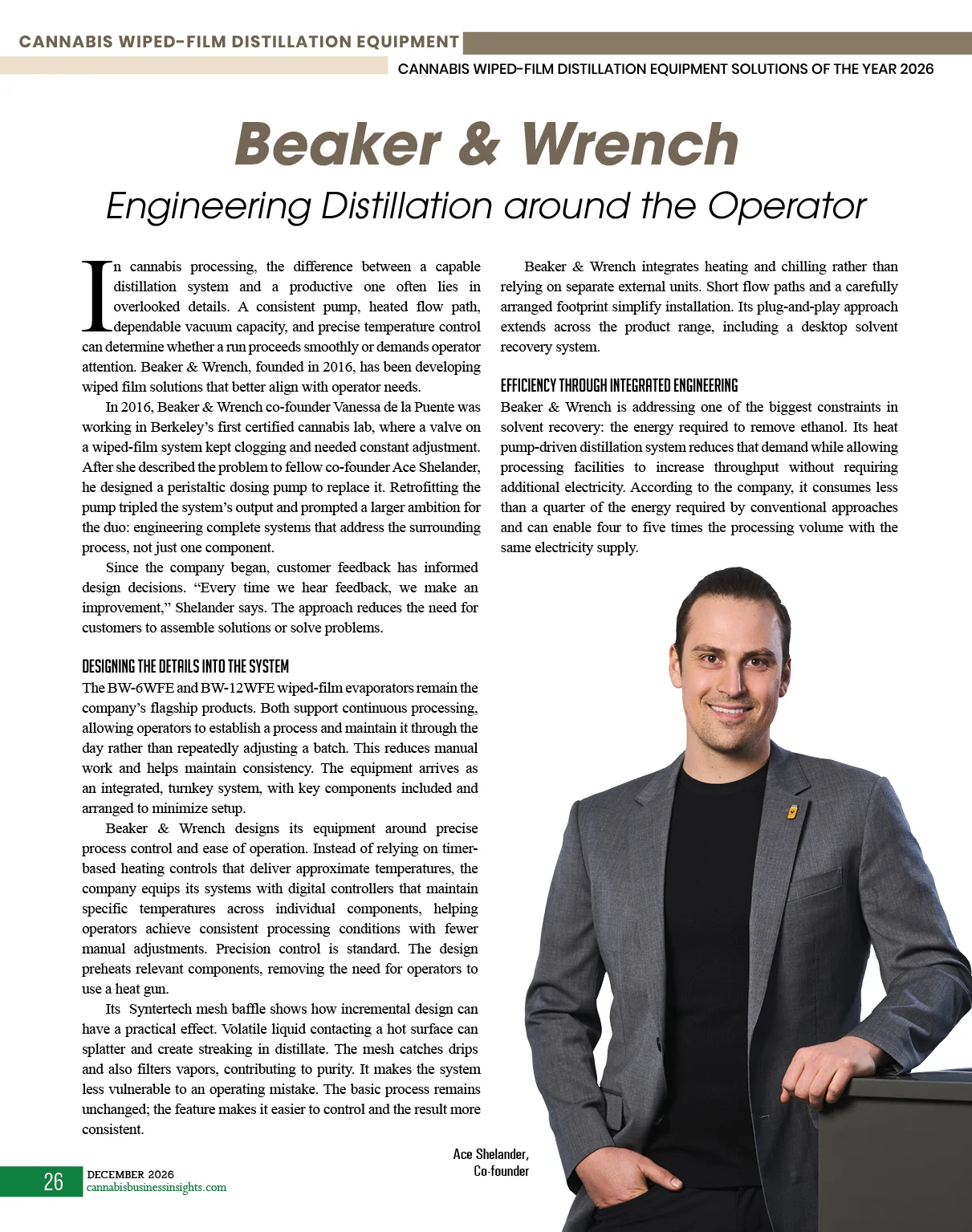
 Ace Shelander, Co-Founder
In 2016, Beaker & Wrench co-founder Vanessa de la Puente was working in Berkeley’s first certified cannabis lab, where a valve on a wiped-film system kept clogging and needed constant adjustment. After she described the problem to fellow co-founder Ace Shelander, he designed a peristaltic dosing pump to replace it. Retrofitting the pump tripled the system’s output and prompted a larger ambition for the duo: engineering complete systems that address the surrounding process, not just one component.
Since the company began, customer feedback has informed design decisions. “Every time we hear feedback, we make an improvement,” Shelander says. The approach reduces the need for customers to assemble solutions or solve problems.
Designing the Details into the System
The BW-6WFE and BW-12WFE wiped-film evaporators remain the company’s flagship products. Both support continuous processing, allowing operators to establish a process and maintain it through the day rather than repeatedly adjusting a batch. This reduces manual work and helps maintain consistency. The equipment arrives as an integrated, turnkey system, with key components included and arranged to minimize setup.
Beaker & Wrench designs its equipment around precise process control and ease of operation. Instead of relying on timer-based heating controls that deliver approximate temperatures, the company equips its systems with digital controllers that maintain specific temperatures across individual components, helping operators achieve consistent processing conditions with fewer manual adjustments. Precision control is standard. The design preheats relevant components, removing the need for operators to use a heat gun.
Its Syntertech mesh baffle shows how incremental design can have a practical effect. Volatile liquid contacting a hot surface can splatter and create streaking in distillate. The mesh catches drips and also filters vapors, contributing to purity. It makes the system less vulnerable to an operating mistake. The basic process remains unchanged; the feature makes it easier to control and the result more consistent.
Beaker & Wrench integrates heating and chilling rather than relying on separate external units. Short flow paths and a carefully arranged footprint simplify installation. Its plug-and-play approach extends across the product range, including a desktop solvent recovery system.
Efficiency through Integrated Engineering
Beaker & Wrench is addressing one of the biggest constraints in solvent recovery: the energy required to remove ethanol. Its heat pump-driven distillation system reduces that demand while allowing processing facilities to increase throughput without requiring additional electricity. According to the company, it consumes less than a quarter of the energy required by conventional approaches and can enable four to five times the processing volume with the same electricity supply.
A facility’s available heat and electrical capacity can restrict production. Increasing output within existing utility limits helps operators use their space and infrastructure more effectively. Energy savings can also reduce operating costs and emissions. The impact varies by scale, but the technology can improve solvent recovery without adding higher energy costs.
-
Every time we hear feedback, we make an improvement.
Automation is another part of the portfolio, although Beaker & Wrench distinguishes continuous processing from closed-loop automation. Its 12-inch system uses onboard computer control to manage valves and reduce operator actions. The solvent recovery system goes further: sensors feed a control loop that adjusts the process and maintains a selected residual-solvent level. The goal is equipment that responds to the process, not simply a touchscreen replacing manual controls.
The company is applying the same emphasis on integrated controls and reduced operator intervention to extraction. Its automated chilling and filtration system coordinates the centrifuge, chilling, and filtration stages, managing process adjustments in the background so operators spend less time handling individual steps and can achieve more consistent results. Its automated chilling and filtration system coordinates centrifuge-based extraction, reducing operator actions and improving consistency. Together with centrifuges, solvent recovery and decarboxylation equipment, it offers a more complete cannabis processing laboratory.
A Solution Sized to the Operation
Customer engagement begins with production goals, not a predetermined machine. Shelander asks what a facility intends to produce and how much it needs to make. Those answers guide the selection of an existing system or a customized configuration. The company considers the process and required capacity before preparing a quotation, then adapts the equipment when needed. For cannabis customers seeking distillate, established configurations often make the choice straightforward; unusual requirements can lead to a tailored design built around the facility’s production target and process requirements.
Beaker & Wrench works to keep delivery times short by stocking long-lead-time parts. Depending on configuration, equipment can often be delivered in about four weeks. Direct shipping can take as little as three days. Beaker & Wrench includes on-site installation and operator training with every equipment purchase. Shelander visits the client's facility to set up the system, bring it into operation, and train the team to operate it confidently. Beaker & Wrench includes on-site installation and operator training with every equipment purchase. Shelander visits each client's facility to install the equipment, get the system running, and train the client's team. The company reports that installations have consistently been completed within a single day over the past five years.
Customers can contact the company throughout the equipment’s life for troubleshooting, parts, and technical support Beaker & Wrench takes its warranties seriously and aims to resolve problems. Reliable uptime is essential to generating a strong return on investment, as equipment delivers value only when it is operating consistently.
One example Shelander shared was Lion Labs, which previously operated with an unreliable system. After purchasing Beaker & Wrench's BW-6WFE wiped-film system, the company increased productivity three- to fourfold, expanded its laboratory operations, and brought product development in-house, including chocolate edibles. Beaker & Wrench describes the change as a three- to fourfold increase in productivity. The case shows how dependable equipment can help a laboratory increase output and pursue products beyond its previous capacity.
Quality, Customization and what comes next
The company has obtained UL 508A, ISO 9001, and applicable CE certifications, demonstrating its commitment to manufacturing quality, product safety, and engineering standards. Shelander says the certification process strengthened documentation and prompted minor design updates, while formalizing quality and engineering practices already in place. Documentation, manufacturing discipline, and design review support confidence in the finished equipment.
Research and development also draws on first principles. For specialized projects, the team considers energy requirements, flow rates, volumes and the physical demands of the process, then designs around those parameters. Existing platforms provide a foundation, but projects may require changes to chillers, vacuum pumps or flow rates. Testing and practical experience guide refinements.
Beaker & Wrench’s next phase combines a fuller cannabis processing portfolio with opportunities in other industries. The company plans to develop a broader range of sizes and apply its engineering capabilities to specialized processes beyond ethanol extraction, building on existing technologies while remaining open to new applications and custom requirements.
After ten years in the industry, Beaker & Wrench continues to focus on developing reliable equipment that simplifies clients' processing operations. As Shelander puts it, “We want their life to be easy,” reflecting the company's commitment to reducing operational challenges through thoughtful engineering, straightforward installation, and responsive technical support. This approach has earned Beaker & Wrench recognition as Cannabis Wiped-Film Distillation Equipment Solutions of the Year for 2026. The recognition reflects the company's emphasis on customer feedback, dependable equipment design, consistent production, and minimizing operational downtime.
